
(French version of this page here.)
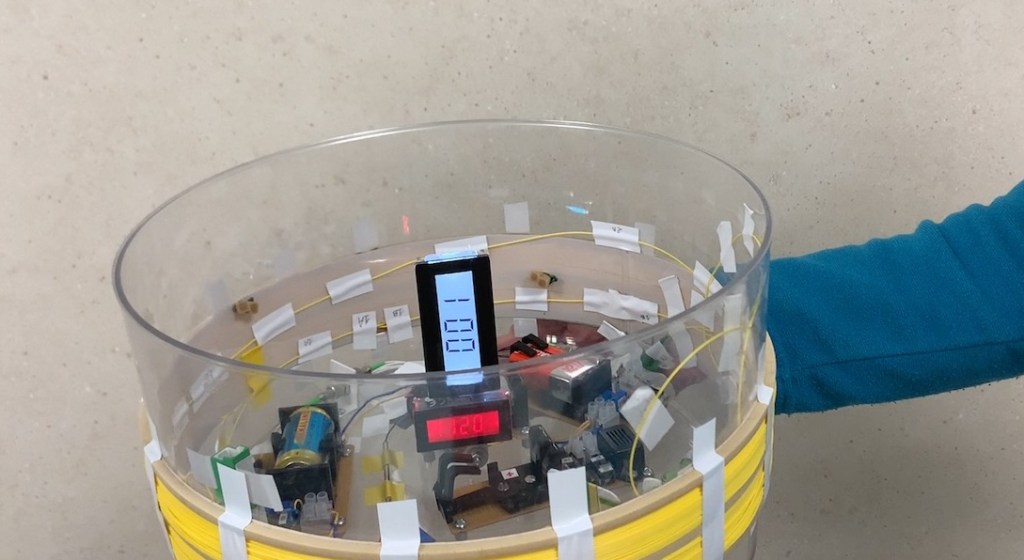
– non-technical introduction,
– scientific article to download, the five embedded videos can be viewed here via the links below the article,
– for potential use, links to the five original HD videos.
Non-technical introduction
The theory of relativity is reputed to apply only when the speeds of moving objects are comparable to the speed of light. With the device shown here, Relativity theory already comes into play when it is rotating and its outer rim is moving at just a few centimeters per second. It contains no moving internal parts. Two light waves (infrared), originating from the same laser diode, travel in opposite directions through the fiber-optic coil (located in the yellow tube visible in the photos in the article and in the videos below). When the two waves meet in the detector, the interference pattern between them depends on the respective times each wave takes to travel from the emitter to the detector. At every point along the fiber, the propagation speed of each wave is determined by the material of the optical fiber (approximately two-thirds of the speed of light in a vacuum).
According to Galilean (« classical ») kinematics, the two travel times in question depend only on the two distances to be traveled and the two speeds imposed along the fiber. The interference pattern should therefore always be the same, whether the interferometer is at rest or rotating at any speed, and the detector should display a single, consistent value.
According to Lorentzian (“relativistic”) kinematics, when the fiber is rotating relative to the laboratory, and a wave travels one millimeter along the fiber, it takes a certain fraction of a second as measured in the reference frame defined by that millimeter of fiber, but a slightly longer fraction of a second in the laboratory’s reference frame. This is known as the relativity of time, or more precisely, the relativity of durations. Furthermore, the difference between the two fractions of a second is not the same for a wave propagating in the same direction as the interferometer’s rotation as it is for a wave propagating in the opposite direction. We can therefore see that, after each wave has completed its path, there may be a phase shift between them that is not predicted by classical kinematics. Using relativistic formulas, we can write precise calculations for the propagation times of each of the two waves. In this case, we find that the difference between these two times depends on the rotation speed of the interferometer, and that this dependence is, in fact, sinusoidal. As the interferometer is spun faster and faster, the detector should then display a value that varies according to a sinusoidal law.
The videos show what happens. The device is indeed sensitive to rotation around the coil’s axis, and insensitive to translation and tilt. And as the rotational speed gradually increases, a sinusoidal variation is clearly visible on the display.
It is true that this phenomenon involves very small time differences. But the wavelength of a light wave—even an infrared one—is also very small. As a result, a small time shift can, when two such waves are superimposed, result in a difference of a non-negligible fraction of a wavelength—or even several wavelengths—and thus lead to a detected light intensity that is highly sensitive to the rotation speed.
Thus, when you rotate the interferometer in your hands and see the numbers on the display scrolling instead of remaining static, you are experiencing the relativity of time.
Article
Video 1
Video 2
Video 3
Video 4
Video 5
The five original videos

